Knowledge Base · Process Design

What is a process status model?

Definitie

A process status model describes all possible states that an object (e.g. an order, invoice or request) passes through in a business process — from initial to completed or cancelled.

In het kort

A process status model describes all possible states of an object in a process — from requested to completed — including permitted transitions and triggers per step. It is the basis for correct ERP configuration and automatic status updates by AI agents. Every core process has exactly one status model.
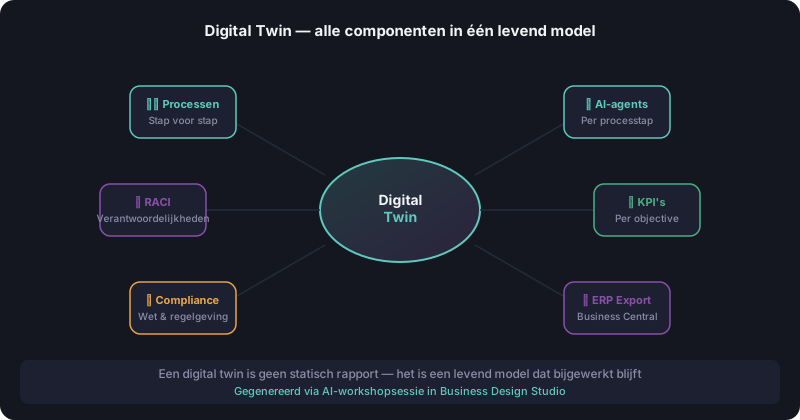
Digital Twin components diagram — processes, RACI, KPIs, AI agents, compliance and ERP export connected in one model
The 6 components of an organisation digital twin — all connected in Business Design Studio

Why define a status model?

Without an explicit status model, process errors occur: staff don't know what stage an object is at, systems synchronise incorrectly and reports are inaccurate. A status model makes process control explicit and configurable in ERP.

Example: status model for a purchase order

StatusMeaningResponsible role
DraftOrder created but not yet approvedPurchaser
Pending approvalAwaiting authorisationManager
ApprovedReady to send to supplierPurchaser
ConfirmedSupplier has confirmedSystem / AI agent
ReceivedGoods or service deliveredWarehouse
InvoicedInvoice received and verifiedFinance
ClosedPaid and completedFinance

Status model in Business Design Studio

Business Design Studio captures the status model of each core process during the canvas phase. For each status, permitted transitions, triggers and responsible roles are recorded — directly exportable as ERP configuration for Business Central.

Frequently asked questions

How does a status model differ from a process flow?
A process flow describes activities (what is done). A status model describes the state of the object (what it is). Both are complementary: activities are the transitions in the status model.
Is a status model required for ERP configuration?
Not formally, but strongly recommended. ERP systems like Microsoft Business Central work internally with status fields. Without an explicit status model, inconsistencies arise in the configuration.
Can an AI agent update object status automatically?
Yes. An AI agent can automatically trigger status transitions based on events — e.g. automatically moving from 'Confirmed' to 'Received' upon receipt of a delivery confirmation.
How many statuses does a typical process status model have?
Typically 4–8 statuses per object. Fewer than 4 gives insufficient progress visibility; more than 10 makes the model unmanageable. Add a status when there is a demonstrable difference in who is responsible or what action follows.
What is a terminal status and why is it important?
A terminal status is a final state from which no further transitions are possible (e.g. 'Completed' or 'Cancelled'). Every flow must have at least one terminal status. Missing terminal statuses lead to 'zombie records' that are never closed.
Can an AI agent automatically execute status transitions?
Yes, this is one of the most valuable applications. The AI agent monitors triggers (e.g. receipt of a confirmation) and executes the status transition automatically — including notifications to the Informed roles from the RACI matrix.

See this concept in action

Business Design Studio applies all these concepts in a voice-driven AI workshop — try it free with no registration required.

Try free demo
📚External reference: Wikipedia: Finite-state machine ↗